Manufacturing
Uniform Design Service
Custom uniform design from your brand guidelines: garments, colours and working details turned into a sampled, sealed range ready for production.
- Brand colours are lab-dipped on the actual range fabrics and approved in daylight before bulk
- Fit samples and logo stitch-outs are worn by real staff before the standard is sealed
- The patterns, tech packs and decoration files developed for your range are yours
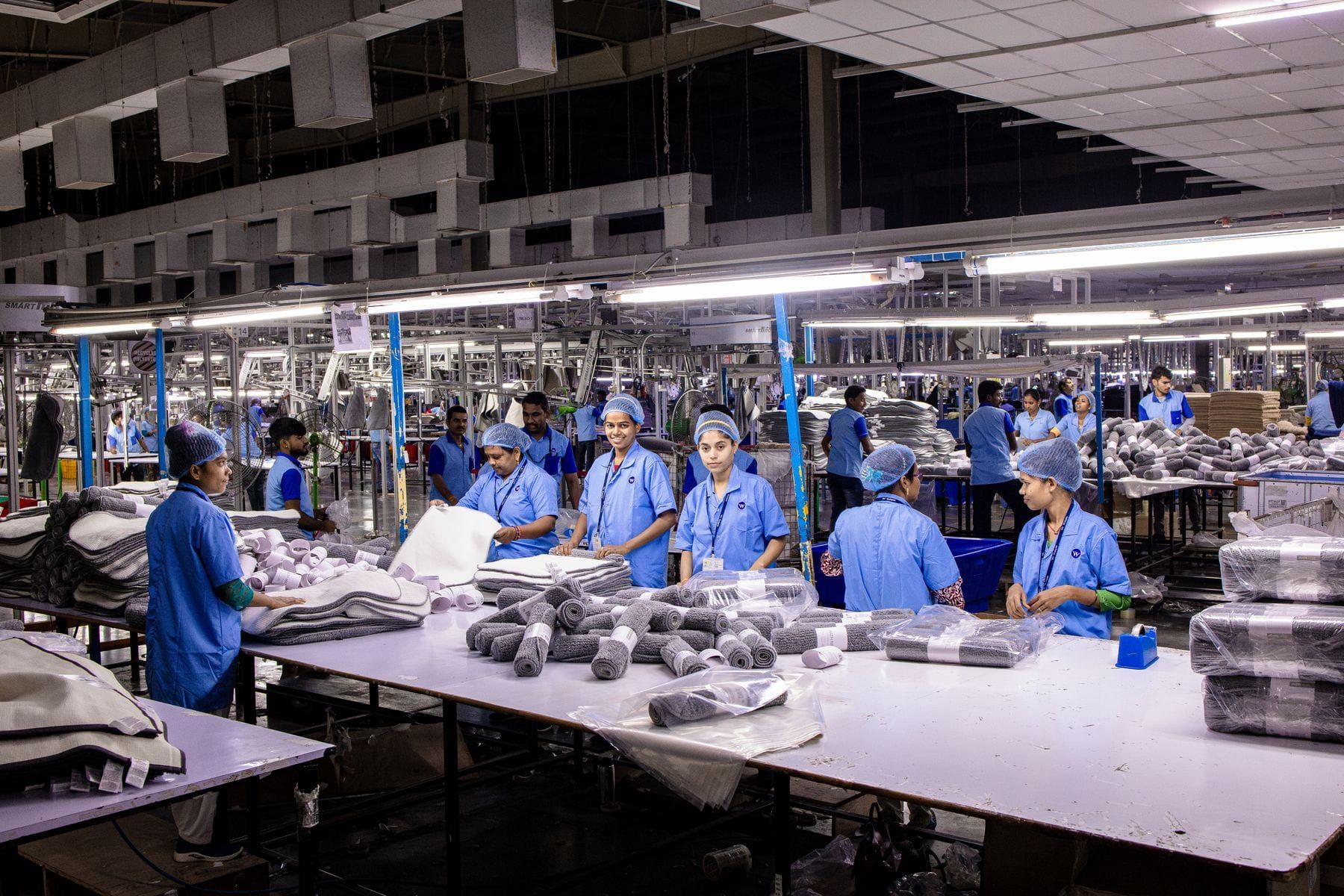
- Design and manufacture sit under one roof, so the range is drawn around cloth we can source and re-source
A uniform range designed from brand guidelines succeeds when it looks like the brand and works like a uniform — and those two demands negotiate with each other from the first sketch. Brand guidelines were written for print and pixels, not for cloth; the design work is the translation between them.
From brand book to garment list
A brand book gives you colours, typography, tone and logo rules. A uniform needs garments, cloths, fits and a laundry plan. The design decides which pieces carry the identity, where the brand colour appears — a whole shirt, a collar stand, a scarf — and which rules have to bend: clear-space requirements mean something different at 90 mm on a chest than on a magazine page. Where starting from zero adds nothing, we adapt an existing block and say so.
Colour on cloth, not on screen
The single most valuable step is the lab dip. A brand colour approved on a monitor can disappoint dyed on poplin, and the same dip reads differently on piqué’s texture or gabardine’s twill. Dips are produced on the actual range fabrics and judged in daylight by your brand team, and the approved dips become the colour standard every re-order is checked against.
Working details are design decisions
The details that make a uniform work are chosen at design stage, not discovered after issue. Pocket layouts follow what the wearer carries — a phone pocket gets a flap, a key loop sits at the waist, every loaded corner is bar-tacked. Underarm gussets and side vents keep a tunic in place when the wearer reaches or bends; closures are chosen for the laundry that will handle them. Signature details — contrast stitching, branded buttons, a woven tab — carry identity at lower cost than a second logo, and all of them are fixed on the sealed sample.
Designed for the second order
A uniform earns its keep on the re-order, so the range is designed from materials with a supply chain behind them: stock-supported fabrics where possible, trims we can source again, colours locked to dips and codes. The tech pack and sealed samples are held by both sides, and every re-order is measured against them — design treated as the first chapter of a programme, not a one-off event. Development runs through sample development with the sealed sample as the finish line.
Industry-specific design
Kitchens and dining rooms have their own design constraints, and we run dedicated versions of this service for them: see the chef uniform design service and the restaurant uniform design service pages.
Ownership and honest limits
The designs are yours: patterns, tech packs and decoration files are documented and handed over, which also makes every future order faster, whoever manufactures it. Two limits are worth stating plainly. We do not design brand identities or logos — artwork must be supplied. And a design service cannot rescue an undecided brand: a uniform range seals decisions into cloth for years, and it is a poor medium for experiments.
§ 01When Buyers Need This
Situations this service answers
If none of these describe your project, this probably is not the step you need — tell us what you are actually trying to solve.
- You have brand guidelines but no uniform designs, and the range must be designed before it can be manufactured
- A rebrand means the uniform range has to be redesigned alongside the new identity
- You have a logo and references but no tech pack
- You are replacing a dated uniform with a designed range rather than a catalogue pick
§ 02Our Process
How this step runs
- 01
Reading the brief
We extract what a garment can carry from your brand book — palette, tone, logo rules — and flag what cannot translate, with alternatives proposed.
- 02
Range proposal
Garments, colours, fabrics and trims per role are presented together as a costed range plan, with the reasoning attached.
- 03
Colour translation
Brand colours become lab dips on the actual fabrics, judged in daylight, because a Pantone on paper reads differently dyed on poplin or piqué.
- 04
Sampling
Fit samples and stitch-outs on the chosen fabrics are worn by real staff where possible, then revised in one consolidated round.
- 05
Sealing
The approved samples and tech packs become the production standard, held by both sides as the reference for every re-order.
§ 03What We Need From You
Inputs required
The faster these arrive, the fewer rounds development takes.
- Brand guidelines and vector logo files, or reference garments and photography where no guidelines exist
- The role list the range must cover, with headcounts and any tiering between roles
- The practical constraints — laundry method, climate, what wearers carry all shift
- One consolidated round of stakeholder comments after the prototypes
§ 04Options
Choices available
- Design from our existing blocks restyled to your identity, or patterns drafted from scratch
- Signature details: contrast stitching, branded buttons, custom zip pulls, woven tabs
- Working details specified per role: pocket layouts, vents, gussets, key loops
- A two-tier range — client-facing and back-of-house versions of one identity
- Lookbook samples ahead of bulk for internal approval decks
§ 05Limitations
What this cannot do
Constraints stated up front are cheaper for both of us than constraints discovered in production.
LimitationsWhat this cannot do
- 01We do not design brand identities or logos; artwork must be supplied
- 02A design service cannot rescue an undecided brand — if the guidelines themselves are still in flux, finalise them first
- 03The process assumes one consolidated revision round after prototypes; drip-fed comments stretch the calendar
- 04Fabric dyeing cannot hit every Pantone exactly; the lab dip shows the honest achievable colour
- 05Designs are built from materials with a supply chain behind them, so one-off novelty trims that cannot be re-ordered are declined
§ 06Quality
How it gets verified
- Lab dips are approved on the actual range fabrics, side by side, before any colour commitment
- Samples are wear-tested for reach, bending and kneeling where the role demands it
- The logo is stitched out and approved on every fabric in the range, not just one
- The sealed sample and tech pack are the reference every re-order is measured against
Step 12 of 13
Where this sits in production
Every order runs through the same sequence. Each step has its own page, its own approval, and its own way of going wrong.
- 01Private Label Uniforms
- 02OEM / ODM Uniform Manufacturing
- 03Sample Development
- 04Fabric Sourcing
- 05Pattern Making & Fit
- 06Size Grading
- 07Logo Embroidery & Printing
- 08Labels, Name Badges & Packaging
- 09Bulk Production
- 10Quality Control
- 11Uniform Programme Management
- 12Uniform Design
- 13Plus Size & Extended Size Uniforms
← Before this
Uniform Programme Management
Company uniform programmes managed end to end: one garment list per role, sealed samples, per-site packing, and re-orders that match the first delivery.
After this →
Plus Size & Extended Size Uniforms
Extended size uniform manufacturing: XS–5XL graded from men's and women's blocks, sizes beyond 5XL drafted as a separate block, fit-proven across the run.
Related Uniforms
Products this applies to
§ 08FAQ
Uniform Design — common questions
Frequently asked13 Q
How does the sampling process work before bulk production?
We start from your tech pack, reference garment or a brief, then make a pre-production sample in the agreed fabric and colour with your logo applied. You review the sample, we revise it if needed, and once approved it is sealed as the reference for bulk production. Where a fabric or finish is new to your project, we wash-test the sample before sending it so you see how it behaves after laundering.
What logo file format do you need?
Vector files (AI, EPS or PDF) are preferred because they scale cleanly for both embroidery and printing. A high-resolution PNG is acceptable, as we can digitise it for embroidery, but small text and fine lines may need to be simplified. Please also send Pantone references or a physical colour swatch so thread and ink colours can be matched.
How much does a sample cost and how long does it take?
Sampling typically takes 7–15 days once the fabric, logo and fit details are agreed. Sample cost is quoted per project, as it depends on whether the fabric is in stock, how many logo positions are involved and how many styles you need. Sample charges are commonly offset against the bulk order once it is confirmed, and this is stated in the quotation.
Do you offer separate men's and women's fits?
Yes. Most of our uniform styles are patterned in both a men's and a women's fit, with differences in shoulder, chest, waist shaping and length, and we can also supply a unisex block if you prefer one chart for the whole team. We recommend including both fits in the sample round so staff can try them before you place the bulk order.
Should our logo be embroidered or printed?
Embroidery is the usual choice for polos, shirts and chef coats because it withstands repeated laundering and reads as more formal. Printing (screen or heat transfer) suits large-area artwork, fine gradients or lightweight fabrics where stitching would be heavy. Many customers use embroidery on the chest and printing for back panels or slogans, and we will advise which method suits each position.
Can uniforms be colour-coded by department or role?
Yes. Colour coding is commonly done with different body colours, contrast collars or piping, sleeve tape, or a coloured department label at the chest or hem. Each colour variant is treated as a separate fabric lot, so let us know the department split when you request a quote and we will confirm minimums per variant.
Which fabrics do you keep in stock and which do you source to order?
We regularly run polycotton twill, cotton drill, pique, oxford, poplin, polyester-spandex, gabardine and fleece or softshell, and standard colours in these are usually available quickly. Special colours, weights or finishes are sourced to order from our mills, which adds fabric lead time that is confirmed in the quotation. Send us a swatch or a reference garment and we will tell you which route applies.
Can you match a Pantone colour across different fabrics?
We can lab-dip to your Pantone reference, but the same colour will look slightly different on a cotton twill, a polyester pique and a softshell because each fibre takes dye differently. For a multi-garment uniform programme we recommend approving a lab dip for each fabric together so the set reads as one colour family. Approved lab dips are kept on file for re-orders.
Will the uniforms hold up to industrial laundering?
Polycotton twill, cotton drill and polyester-rich fabrics are the usual choices for garments that go through commercial laundries, and we specify fabrics and threads accordingly. On request we wash-test the sample and report colourfastness and shrinkage before you approve it. Tell us your laundering method and temperature when you enquire so we can select fabric and construction to suit.
Do you offer wrinkle-free or easy-care finishes?
Yes. Easy-care finishes are available on poplin, oxford and polycotton twill for shirts and trousers, and polyester-blend fabrics naturally resist creasing. The finish is confirmed on the sample so you can check the hand feel, and any additional fabric cost is shown in the quotation.
Can we send you an existing uniform to copy?
Yes. Send a reference garment and we will take the pattern and measurements from it, match the fabric as closely as possible, and make a counter sample for your approval. Where the original fabric is not available we will propose the nearest option and show you both swatches. This is one of the most common ways our customers move a uniform programme to us.
Can we get a size set for a fit trial before bulk?
Yes. After the sample style is approved we can make a graded size set so staff of different builds can try them on before you finalise the size breakdown. The size set is charged per garment and quoted per project, and any measurement adjustments you request are applied to the pattern before bulk cutting.
What information should we send to get a quote?
Send the garment types, approximate quantity per style, preferred fabric or a reference garment, logo artwork with placement, and the destination country. If you have a size breakdown, a target price or a required delivery date, include those too. With this we can return a quotation covering price, MOQ, sample terms and lead time.
Request for quotation
Need uniform design for your project?
Send your product requirements and we will come back with a plan for this step and a quotation for the whole order.
What to sendRFQ
- 01Logo file (AI / PDF / PNG)
- 02Styles and colours
- 03Quantity per style
- 04Size range or headcount
- 05Deadline and destination
Minimum order starts at 100 pcs per style; exact MOQ is quoted per project.