Manufacturing
Bulk Uniform Production
Bulk uniform production: cut plan by size ratio, fabric colour continuity, in-line checks and re-orders for new starters against retained patterns.
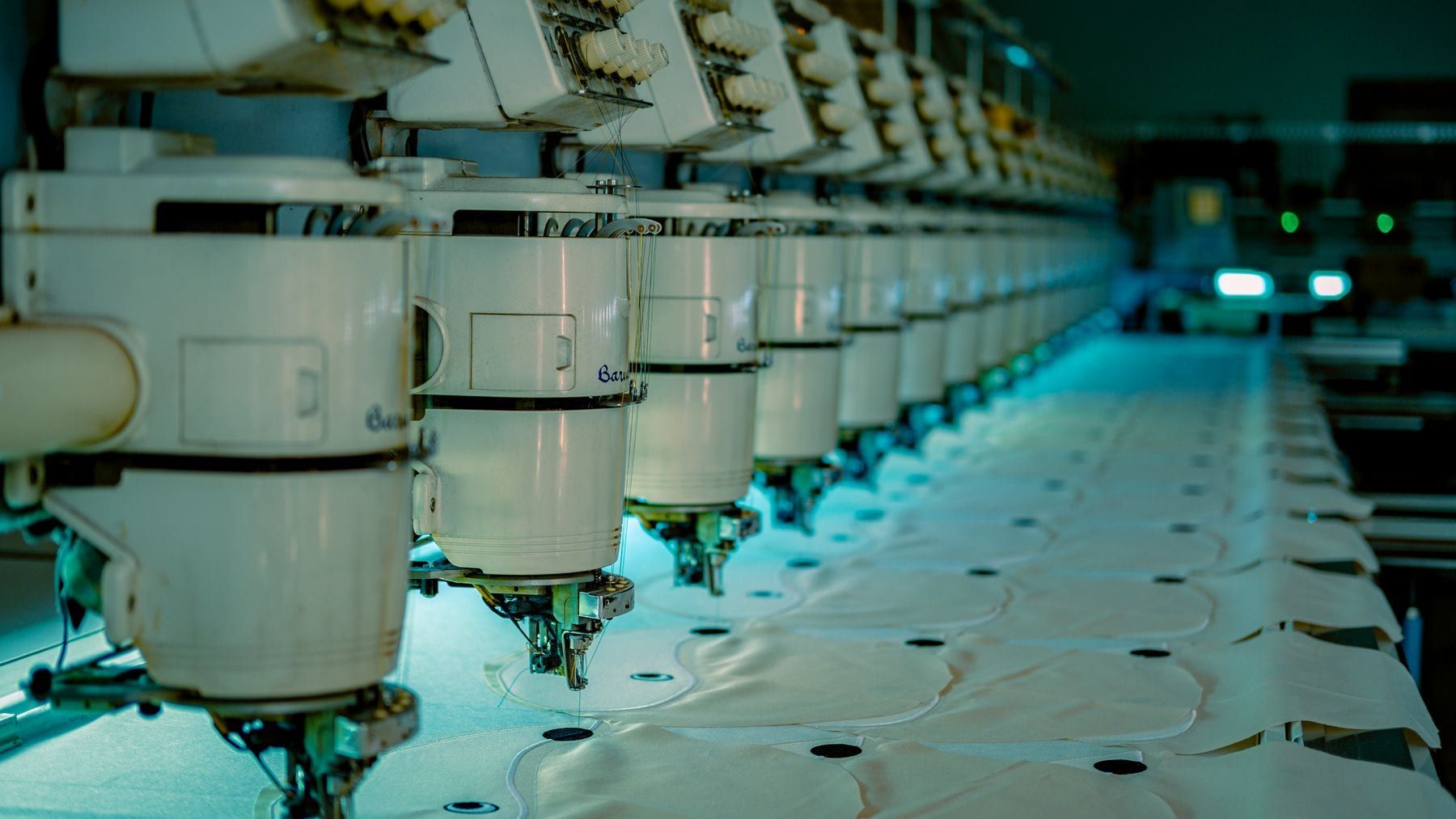
- Cutting is planned from your size ratio, with fabric shade-grouped so each garment is cut from one shade
- The signed pre-production sample stays on the line as the reference for every operator
- Patterns, logo files and label stock are retained so re-orders match the first delivery
- Established 2006, producing uniforms for corporate, hospitality, school, medical and workwear buyers
Bulk production is where a uniform programme becomes boxes of garments. By this stage the pattern, grading, fabric, branding and packing have all been decided and approved on samples, and the job of the factory is to reproduce the approved sample in every size and colour without drift. The order is planned around the size ratio, the fabric is controlled for colour, and the output is inspected against the sealed sample before it ships.
Cutting to the size ratio
A uniform order is not a stack of one size. The cut plan starts from your quantity per size, whether that comes from an employee list or a ratio from the previous order. Markers are laid so that fabric is used efficiently across the sizes, and so that every panel of a single garment is cut from the same shade group of fabric. A shirt whose sleeves are a slightly different navy from its body is the most visible fault a uniform can have, and it is avoided at the cutting table, not caught afterwards.
Where a programme mixes garment types in the same colour, such as polos and jackets, they are cut and sewn in the same production window from fabric checked against the same reference, so the set matches when it is worn together.
The ratio itself is planned with you under size grading.
Colour continuity across batches and sites
Buyers dressing several sites need the second site’s delivery to match the first. We record the mill, quality and dye lot for every order, and bulk fabric for each batch is compared with the approved lab dip before it is cut. When a programme is delivered in phases, we cut from the same dye lot where quantities allow. When a new lot is unavoidable, it is checked against the original swatch and the difference, if any, is reported to you before cutting.
How lab dips and dye lots are managed is explained under fabric sourcing.
Re-orders for new starters
Staff turnover means uniform programmes are re-ordered in small quantities long after the first delivery. We retain the graded patterns, the digitised logo files, the placement standards, the label stock and the sealed sample, so a top-up order for twenty new starters is cut from the same pattern and decorated from the same file. Fabric for a re-order in a stock colour is checked against the retained swatch; a re-order in a custom colour needs a new dye lot and is matched within the agreed tolerance. Many buyers hold a small buffer in the mid sizes from the first order and re-order the ends by name.
Minimum order typically starts at 100 pcs per style; exact MOQ is quoted per project. Production lead time depends on fabric availability, order size and decoration, and is confirmed in the quotation rather than promised on this page. Changes after cutting has started, to quantity, colour or branding, mean re-cutting and are charged, which is why the size ratio and employee list are frozen at sample sign-off.
The sealed sample the re-order is cut against comes from sample development; the finished order is checked under quality control.
§ 01When Buyers Need This
Situations this service answers
If none of these describe your project, this probably is not the step you need — tell us what you are actually trying to solve.
- Your samples are approved and you need the full programme produced for a rollout date
- You are dressing several sites and need the same garment delivered in matching colour to each
- You need a top-up order for new starters that matches what existing staff already wear
- Your previous supplier delivered inconsistent colour or sizes between batches
- You want a single factory to cut, sew, decorate, label and pack rather than coordinating several
§ 02Our Process
How this step runs
- 01
Order confirmation
Quantities per style, colour and size are confirmed against the approved samples and the size ratio.
- 02
Fabric and trim receipt
Bulk fabric is inspected, shade-grouped and matched to the approved lab dip; trims and labels are counted against the order.
- 03
Cut plan
Markers are laid by size ratio and shade group so that body, sleeves and collar of each garment come from one shade.
- 04
Sewing
Garments are sewn to the pre-production sample, with in-line checks on seams, measurements and construction points.
- 05
Decoration and labelling
Logos, names and labels are applied to the approved placement standard.
- 06
Finishing and pressing
Threads are trimmed, garments pressed and folded to the packing specification.
- 07
Final inspection and packing
A random inspection against the sample is carried out before garments are packed per the packing list and shipped.
§ 03What We Need From You
Inputs required
The faster these arrive, the fewer rounds development takes.
- Signed approval of the pre-production sample and size-set sample
- Final quantities per style, colour and size, or an employee list for per-person orders
- Confirmed logo files, placement standards and label artwork
- Packing and delivery specification, including carton marks and destination sites
- Any ship date or rollout date the order must meet, so it can be confirmed in the quotation
§ 04Options
Choices available
- Production by size ratio, or per employee from a named list
- Mixed-style programmes cut and sewn together so colours match across garment types
- Split deliveries by site or by phase of a rollout
- Buffer stock in mid sizes held for new starters
- Re-orders from retained patterns, files and label stock
- Fabric from stock qualities, custom dye lots or buyer-supplied rolls
§ 05Limitations
What this cannot do
Constraints stated up front are cheaper for both of us than constraints discovered in production.
LimitationsWhat this cannot do
- 01Production lead time depends on fabric availability and order size and is confirmed in the quotation, not promised in advance
- 02Changes to quantity, colour or branding after cutting has started mean re-cutting and are charged
- 03Re-orders in a custom colour depend on a new dye lot, which may differ slightly from the original within tolerance
- 04Garment dyeing and garment washing are not done in-house
- 05We do not produce certified protective clothing such as hi-vis, flame-retardant or arc-flash garments
§ 06Quality
How it gets verified
- Bulk fabric is compared with the approved lab dip and shade-grouped before any marker is cut
- In-line inspection checks measurements at key points against the chart while sewing is in progress
- Logo placement is checked with a template at intervals through the decoration run
- A random final inspection covers measurements, sewing, decoration, labels and packing against the sealed sample
- Inspection results are recorded and available with the shipment
Step 9 of 13
Where this sits in production
Every order runs through the same sequence. Each step has its own page, its own approval, and its own way of going wrong.
- 01Private Label Uniforms
- 02OEM / ODM Uniform Manufacturing
- 03Sample Development
- 04Fabric Sourcing
- 05Pattern Making & Fit
- 06Size Grading
- 07Logo Embroidery & Printing
- 08Labels, Name Badges & Packaging
- 09Bulk Production
- 10Quality Control
- 11Uniform Programme Management
- 12Uniform Design
- 13Plus Size & Extended Size Uniforms
← Before this
Labels, Name Badges & Packaging
Size labels, care labels, woven brand labels, name badges and department tags for uniforms, plus per-employee polybags and cartons packed by location.
After this →
Quality Control
Uniform quality control from fabric inspection through in-line checks, measurement against spec, embroidery placement tolerance and final random inspection.
Related Uniforms
Products this applies to
Related Fabrics
Fabrics this affects
§ 08FAQ
Bulk Production — common questions
Frequently asked16 Q
What is your minimum order quantity for custom uniforms?
Minimum order starts at 100 pcs per style; exact MOQ is quoted per project. The figure depends on the fabric, colour and level of customisation involved, so send us the style, quantity and branding you have in mind and we will confirm the MOQ in the quotation.
How does the sampling process work before bulk production?
We start from your tech pack, reference garment or a brief, then make a pre-production sample in the agreed fabric and colour with your logo applied. You review the sample, we revise it if needed, and once approved it is sealed as the reference for bulk production. Where a fabric or finish is new to your project, we wash-test the sample before sending it so you see how it behaves after laundering.
How long does bulk production take?
Bulk production typically takes 25–30 days after the sample is approved and the order is confirmed. The exact schedule depends on fabric availability, order quantity and the amount of embroidery or printing per garment, and is confirmed in the quotation; we update you at fabric arrival, cutting and final inspection.
Do you make hi-vis, flame-retardant or certified protective clothing?
No. We do not manufacture certified PPE such as EN ISO 20471 hi-vis, flame-retardant, arc-flash or NFPA/ANSI-rated garments. What we do make is everyday workwear and uniforms, including corporate, hotel, restaurant, chef, housekeeping, retail and school uniforms, all with your branding applied.
Can we mix sizes and colours within the minimum order?
Mixing sizes within one style is normal and does not affect the MOQ. Mixing colours is usually possible too, but each colour needs its own fabric lot, so the per-colour quantity may be subject to a minimum. Minimum order starts at 100 pcs per style; exact MOQ is quoted per project, including any per-colour split.
How much does a sample cost and how long does it take?
Sampling typically takes 7–15 days once the fabric, logo and fit details are agreed. Sample cost is quoted per project, as it depends on whether the fabric is in stock, how many logo positions are involved and how many styles you need. Sample charges are commonly offset against the bulk order once it is confirmed, and this is stated in the quotation.
Can uniforms be colour-coded by department or role?
Yes. Colour coding is commonly done with different body colours, contrast collars or piping, sleeve tape, or a coloured department label at the chest or hem. Each colour variant is treated as a separate fabric lot, so let us know the department split when you request a quote and we will confirm minimums per variant.
Which fabrics do you keep in stock and which do you source to order?
We regularly run polycotton twill, cotton drill, pique, oxford, poplin, polyester-spandex, gabardine and fleece or softshell, and standard colours in these are usually available quickly. Special colours, weights or finishes are sourced to order from our mills, which adds fabric lead time that is confirmed in the quotation. Send us a swatch or a reference garment and we will tell you which route applies.
Can you match a Pantone colour across different fabrics?
We can lab-dip to your Pantone reference, but the same colour will look slightly different on a cotton twill, a polyester pique and a softshell because each fibre takes dye differently. For a multi-garment uniform programme we recommend approving a lab dip for each fabric together so the set reads as one colour family. Approved lab dips are kept on file for re-orders.
Will the uniforms hold up to industrial laundering?
Polycotton twill, cotton drill and polyester-rich fabrics are the usual choices for garments that go through commercial laundries, and we specify fabrics and threads accordingly. On request we wash-test the sample and report colourfastness and shrinkage before you approve it. Tell us your laundering method and temperature when you enquire so we can select fabric and construction to suit.
Can we re-order small top-up quantities for new staff?
Yes. Repeat orders are made against your sealed sample and the approved lab dips, so new garments match the original run. Top-up orders are subject to minimums quoted per project, and reserving fabric from the first run can make small repeats easier, so mention expected staff turnover when you place the initial order.
Can you pack uniforms per employee by name and size?
Yes. We can bag each employee's garments together, label the pack with name, department and size, and carton them by site or branch so your team can hand them out without re-sorting. We need the distribution list before packing starts, and any extra packaging cost is confirmed in the quotation.
How do you check quality during production?
Fabric is inspected on arrival for shade and defects, then a pilot run from bulk is measured and compared with the sealed sample before cutting continues. During sewing, inline checks cover seams, logo placement and measurements, and a final inspection is carried out on finished garments before packing. You are welcome to appoint a third-party inspection company, and we will arrange access.
Do you work with uniform distributors and brands?
Yes. A large part of our production is for uniform distributors and workwear brands who resell under their own labels. We can hold approved samples and lab dips on file, run repeat programmes for their end customers and ship blind or with the distributor's own packaging and documentation.
What information should we send to get a quote?
Send the garment types, approximate quantity per style, preferred fabric or a reference garment, logo artwork with placement, and the destination country. If you have a size breakdown, a target price or a required delivery date, include those too. With this we can return a quotation covering price, MOQ, sample terms and lead time.
Do you ship worldwide, and which Incoterms do you use?
Yes. We ship to customers worldwide by sea, air or courier depending on the quantity and urgency. The shipping terms (for example EXW, FOB or CIF) and any freight estimate are agreed with you and confirmed in the quotation, and we can work with your own forwarder if you prefer.
Request for quotation
Need bulk production for your project?
Send your product requirements and we will come back with a plan for this step and a quotation for the whole order.
What to sendRFQ
- 01Logo file (AI / PDF / PNG)
- 02Styles and colours
- 03Quantity per style
- 04Size range or headcount
- 05Deadline and destination
Minimum order starts at 100 pcs per style; exact MOQ is quoted per project.