Manufacturing
Logo Embroidery & Printing for Uniforms
Logo embroidery, screen print, heat transfer and DTF for uniforms. Digitising, stitch count, placement standards and per-employee name embroidery explained.
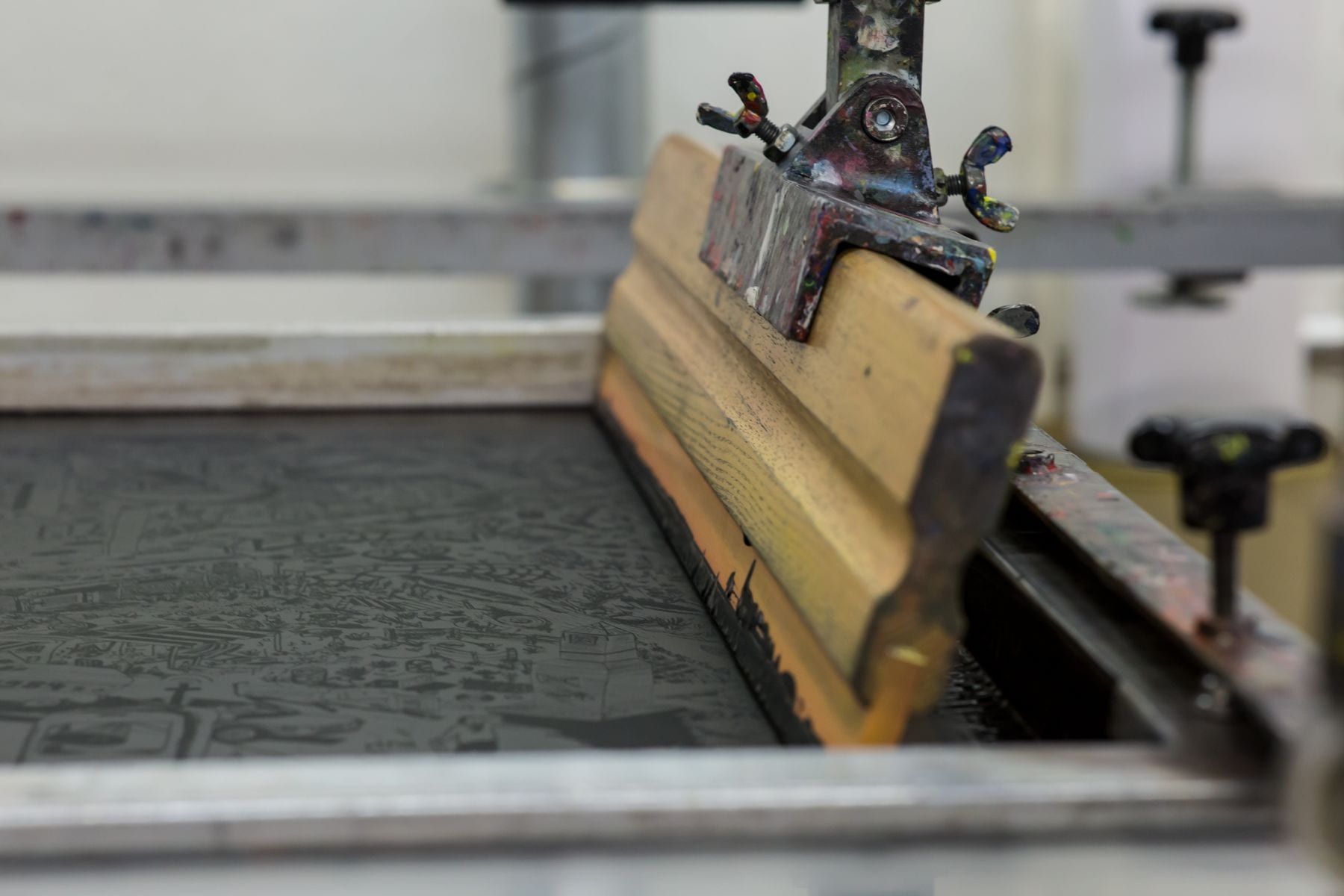
- Every logo is digitised once and the file is retained for all garment types and re-orders
- A stitched or printed strike-off is approved on the actual fabric before bulk decoration
- Placement is measured from fixed garment points and checked against a tolerance during production
- Embroidery, screen print, heat transfer and DTF are all run in-house, chosen per fabric and artwork
The logo is the part of a uniform everyone looks at. It is also the part that most often goes wrong across a programme: a slightly different shade of blue on the polo, a logo sitting higher on the jacket than on the shirt, names misspelled. We handle decoration in-house so that the file, the thread and the placement standard are the same on every garment and every re-order.
Choosing the technique
Embroidery is the default for uniform logos on woven shirts, polos, jackets and caps. It is durable through industrial laundering and reads as a quality mark. Its limits are physical: embroidery cannot reproduce gradients or photographic detail, and text under about 5 mm high fills in and becomes unreadable. Logos with fine text are simplified for embroidery, or the text is dropped to a print.
Screen print suits large flat-colour logos, such as a back print on a hi-visibility-style vest that is not certified PPE, or a run of sweatshirts in one colour. Each colour needs a screen, so it becomes less economical as the colour count rises and the quantity falls. Heat transfer works well on lightweight poplin and on small quantities where a screen is not justified. DTF transfer handles full-colour and gradient artwork on almost any fabric and is the answer for a logo that embroidery cannot reproduce.
Whichever technique is chosen, a strike-off on the actual fabric is made and photographed for approval. For printed and transferred logos, the strike-off is wash-tested on the size-set sample.
Fabric-specific notes are in the piqué guide; heavier fleece-backed and softshell cloths are covered at sampling, where their embroidery behaviour is tested on the actual garment.
Digitising, stitch count and placement
A logo is digitised once. The digitiser sets the stitch types, density and underlay for the fabric it will be sewn on, and the resulting file is retained and reused on every garment type and re-order. A file digitised for pique may need adjustment for a fleece or a cap, and we make that adjustment rather than forcing one file onto every surface. Stitch count is confirmed on the strike-off; a dense logo on a light fabric puckers, and the fix is in the file, not the machine.
Placement is defined in millimetres from fixed points. Left chest is measured down from the shoulder seam and across from centre front; sleeve logos are measured from the shoulder seam; back yoke logos are centred below the collar seam; cap fronts are centred on the front panel. The standard for each garment type is recorded and checked with a template during production against an agreed tolerance.
Placement is verified with a template during quality control.
Names per employee
Name embroidery turns a bulk order into a per-person order. We embroider from your list, with spelling confirmed in writing before we start, and pack each garment with a name and size sticker so the box can be handed out at site without sorting. Department or role text can be added as a second line. Names add a step to production and are quoted per project.
Named garments are packed per employee as described under labels and packaging.
§ 01When Buyers Need This
Situations this service answers
If none of these describe your project, this probably is not the step you need — tell us what you are actually trying to solve.
- You need your logo on the left chest of every shirt and polo, and on the back of every jacket
- Your uniforms come from several suppliers and the logo looks different on each
- You want employee names embroidered so staff can be identified without a badge
- Your logo has fine text or a gradient and you are unsure which technique will reproduce it
- Your programme includes shirts, caps and jackets that each need a different placement
- You need a durable logo that survives industrial laundering
§ 02Our Process
How this step runs
- 01
Artwork review
We check the vector file for line weight, text size and colour count and advise which technique suits each garment.
- 02
Digitising or separation
The logo is digitised for embroidery, with stitch count and underlay set for the fabric, or separated into colours for print.
- 03
Strike-off
A test embroidery or print is made on the actual fabric and photographed for approval. Thread and ink colours are matched here.
- 04
Placement standard
Placement is defined in millimetres from fixed points, such as the shoulder seam and centre front, and recorded per garment type.
- 05
Bulk decoration
Garments or cut panels are decorated to the approved strike-off, with placement checked against the standard.
- 06
Name and department personalisation
Employee names and department text are embroidered or printed from your list, packed and labelled per person.
§ 03What We Need From You
Inputs required
The faster these arrive, the fewer rounds development takes.
- Vector logo file (AI, EPS, PDF or SVG); a JPG or PNG can be redrawn but adds a step and a proof
- Pantone or thread colour references, or a physical sample of the logo you want matched
- Placement instructions per garment type, or a request for our standard placements
- The employee name list with spelling confirmed, if names are to be added
- The fabric and garment type for each position so the technique can be chosen
§ 04Options
Choices available
- Embroidery on chest, sleeve, back yoke, collar, cuff and cap front
- Screen print for large back logos and multi-garment runs in flat colours
- Heat transfer for lightweight fabrics and small quantities
- DTF transfer for full-colour or gradient artwork and photographic logos
- Employee name embroidery under or beside the logo
- Department, role or site text as a second line
- Tone-on-tone embroidery for a subtle corporate look
- 3D puff embroidery on caps
§ 05Limitations
What this cannot do
Constraints stated up front are cheaper for both of us than constraints discovered in production.
LimitationsWhat this cannot do
- 01Embroidery cannot reproduce gradients or photographic detail; those need DTF or screen print
- 02Text under roughly 5 mm high fills in when embroidered and is not legible; small text needs print
- 03Very large embroidered areas make the fabric stiff and can pucker on light fabrics
- 04Screen print carries a screen setup per colour, so small runs with many colours are better as DTF
- 05Heat transfer and DTF are less durable than embroidery under industrial laundering and should be tested on the strike-off
- 06Exact thread colour matches to Pantone are limited to the thread ranges available; we match to the nearest shade
§ 06Quality
How it gets verified
- Strike-offs are approved on the actual fabric so density, pucker and colour are seen before bulk
- Placement is measured with a template from fixed garment points and checked at intervals during the run
- Thread and ink colour are compared with the approved strike-off under daylight at the start of each batch
- Names are checked against the list before embroidery and again when packing per employee
- Printed and transferred logos are wash-tested on the size-set sample before approval
Step 7 of 13
Where this sits in production
Every order runs through the same sequence. Each step has its own page, its own approval, and its own way of going wrong.
- 01Private Label Uniforms
- 02OEM / ODM Uniform Manufacturing
- 03Sample Development
- 04Fabric Sourcing
- 05Pattern Making & Fit
- 06Size Grading
- 07Logo Embroidery & Printing
- 08Labels, Name Badges & Packaging
- 09Bulk Production
- 10Quality Control
- 11Uniform Programme Management
- 12Uniform Design
- 13Plus Size & Extended Size Uniforms
← Before this
Size Grading
Size grading for uniforms from XS to 5XL, separate men's and women's grades, children's 4-16 for schools, and how to plan a size ratio from an employee list.
After this →
Labels, Name Badges & Packaging
Size labels, care labels, woven brand labels, name badges and department tags for uniforms, plus per-employee polybags and cartons packed by location.
Related Uniforms
Products this applies to
Related Fabrics
Fabrics this affects
§ 08FAQ
Logo Embroidery & Printing — common questions
Frequently asked11 Q
How does the sampling process work before bulk production?
We start from your tech pack, reference garment or a brief, then make a pre-production sample in the agreed fabric and colour with your logo applied. You review the sample, we revise it if needed, and once approved it is sealed as the reference for bulk production. Where a fabric or finish is new to your project, we wash-test the sample before sending it so you see how it behaves after laundering.
What logo file format do you need?
Vector files (AI, EPS or PDF) are preferred because they scale cleanly for both embroidery and printing. A high-resolution PNG is acceptable, as we can digitise it for embroidery, but small text and fine lines may need to be simplified. Please also send Pantone references or a physical colour swatch so thread and ink colours can be matched.
Do you make hi-vis, flame-retardant or certified protective clothing?
No. We do not manufacture certified PPE such as EN ISO 20471 hi-vis, flame-retardant, arc-flash or NFPA/ANSI-rated garments. What we do make is everyday workwear and uniforms, including corporate, hotel, restaurant, chef, housekeeping, retail and school uniforms, all with your branding applied.
Should our logo be embroidered or printed?
Embroidery is the usual choice for polos, shirts and chef coats because it withstands repeated laundering and reads as more formal. Printing (screen or heat transfer) suits large-area artwork, fine gradients or lightweight fabrics where stitching would be heavy. Many customers use embroidery on the chest and printing for back panels or slogans, and we will advise which method suits each position.
Can you embroider individual staff names or add name badges?
Yes. We can embroider each employee's name directly on the garment from a list you supply, or add a badge holder, Velcro patch or removable name tag if staff change frequently. Per-name embroidery is priced per garment and needs the final name list before production starts, so it is confirmed in the quotation.
Can you match a Pantone colour across different fabrics?
We can lab-dip to your Pantone reference, but the same colour will look slightly different on a cotton twill, a polyester pique and a softshell because each fibre takes dye differently. For a multi-garment uniform programme we recommend approving a lab dip for each fabric together so the set reads as one colour family. Approved lab dips are kept on file for re-orders.
Will the uniforms hold up to industrial laundering?
Polycotton twill, cotton drill and polyester-rich fabrics are the usual choices for garments that go through commercial laundries, and we specify fabrics and threads accordingly. On request we wash-test the sample and report colourfastness and shrinkage before you approve it. Tell us your laundering method and temperature when you enquire so we can select fabric and construction to suit.
Can you produce uniforms under our own brand with our labels?
Yes. We work OEM/ODM and can sew in your woven or printed main labels, size and care labels, hangtags and branded packaging so the finished garment carries your brand rather than ours. Send label artwork or existing label samples and we will source or produce them to match.
How do you check quality during production?
Fabric is inspected on arrival for shade and defects, then a pilot run from bulk is measured and compared with the sealed sample before cutting continues. During sewing, inline checks cover seams, logo placement and measurements, and a final inspection is carried out on finished garments before packing. You are welcome to appoint a third-party inspection company, and we will arrange access.
Do you work with uniform distributors and brands?
Yes. A large part of our production is for uniform distributors and workwear brands who resell under their own labels. We can hold approved samples and lab dips on file, run repeat programmes for their end customers and ship blind or with the distributor's own packaging and documentation.
Do you make school uniforms with children's sizing and school crest embroidery?
Yes. We produce school polos, shirts, skirts and trousers graded across children's sizes by age or height, and embroider the school crest to your artwork. Blazers and jackets can be added to the same programme. Because school orders cover many sizes in small quantities, send the size breakdown early and we will confirm the MOQ per style in the quotation.
Request for quotation
Need logo embroidery & printing for your project?
Send your product requirements and we will come back with a plan for this step and a quotation for the whole order.
What to sendRFQ
- 01Logo file (AI / PDF / PNG)
- 02Styles and colours
- 03Quantity per style
- 04Size range or headcount
- 05Deadline and destination
Minimum order starts at 100 pcs per style; exact MOQ is quoted per project.